There were seven of us on the tour today, hurtling down the roads of central Anatolia, frost tipped grasses appearing as blurs out the window.
We drove past the Kaymakli underground city, and kept driving into the chilly morning. Our guide today, Ali, explained that we were supposed to stop there early in the tour, but because there were many buses waiting at the site, we would be better off visiting in the afternoon when it wouldn’t be crowded.
I enquired as to whether there are times of the year when the crowds can’t be avoided, and I’m not certain he fully understood the question. I was basically looking for validation regarding my choice to visit in the dead of winter.
Today I am on the Green Tour, which basically follows one of the other rivers here. Most of this valley is fairly arid and brown, but the riverbank is green, and this is where the tour gets its name.

We started with a brief stop at a panoramic overlook of Göreme (pronounced guhr – em – uh), the small village where we are all staying. Ali points to the high tableau in the distance. When the volcanoes here stopped erupting millions of years ago, this entire valley was at about that level, and over the subsequent eons weather and water have eroded it to its current form.
I don’t think most humans can begin to fathom a million years – I certainly can’t. If we live on average about 82 years, our lifetime is about 0.008% of that. Our lifetimes are less than a rounding error in such timescales.
That’s cheerful.
Back into the truck, speeding past Kaymakli, we all napped for the long drive to our next stop, the Selime Cathedral.
This was another site occupied by monks who were taking shelter from the outside world. It remained a Christian site until the Ottomans took power.
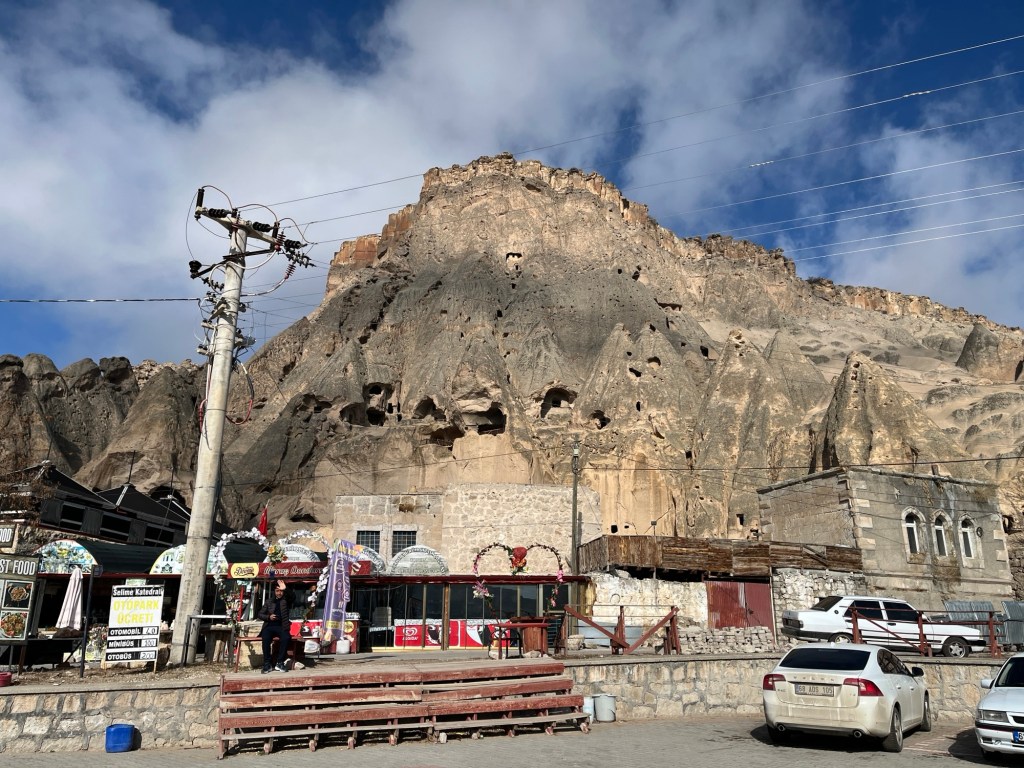
The mountain is pockmarked with holes from where earth and rock were carved away. It looks diseased, in a way.

Happily, we were able to climb to some of the sites here. From the viewing area we had a fantastic view of the valley.
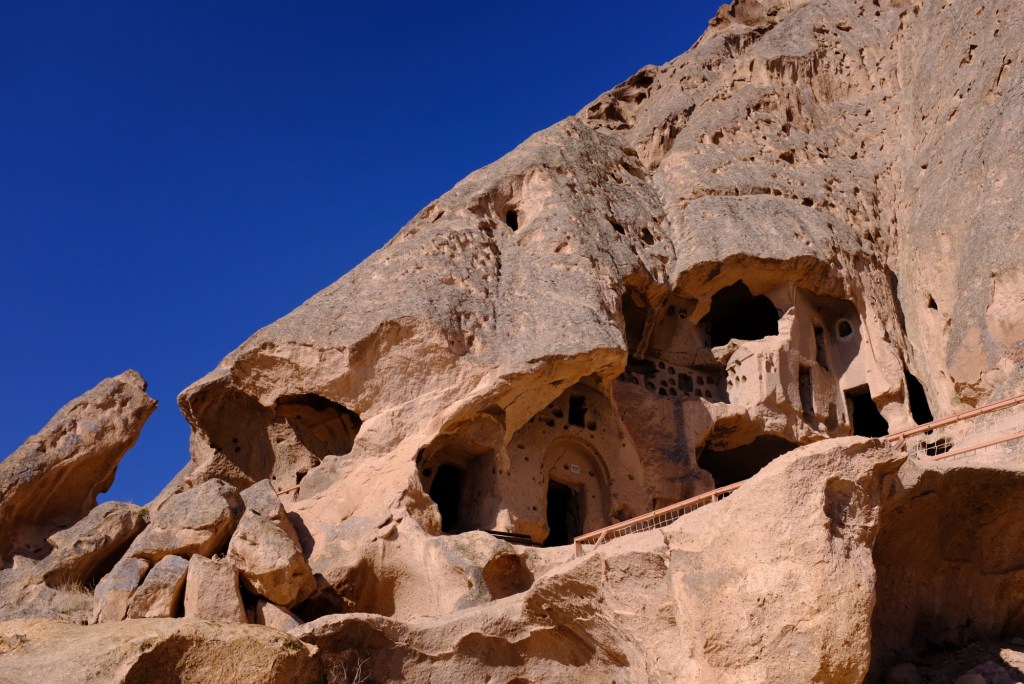
We were granted 30 minutes to explore. At the next level there are a chapel, a church, and the cathedral.
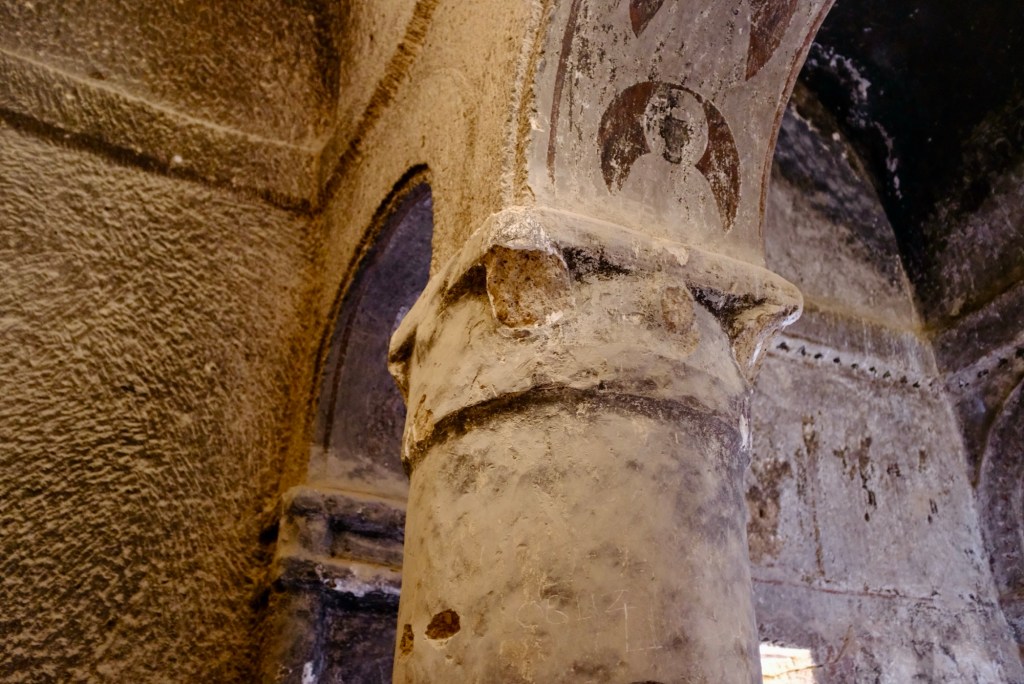
The chapel is first. This is bigger than most of the churches I saw yesterday. Much of the art is gone, but at one time it must have been a sight to behold.
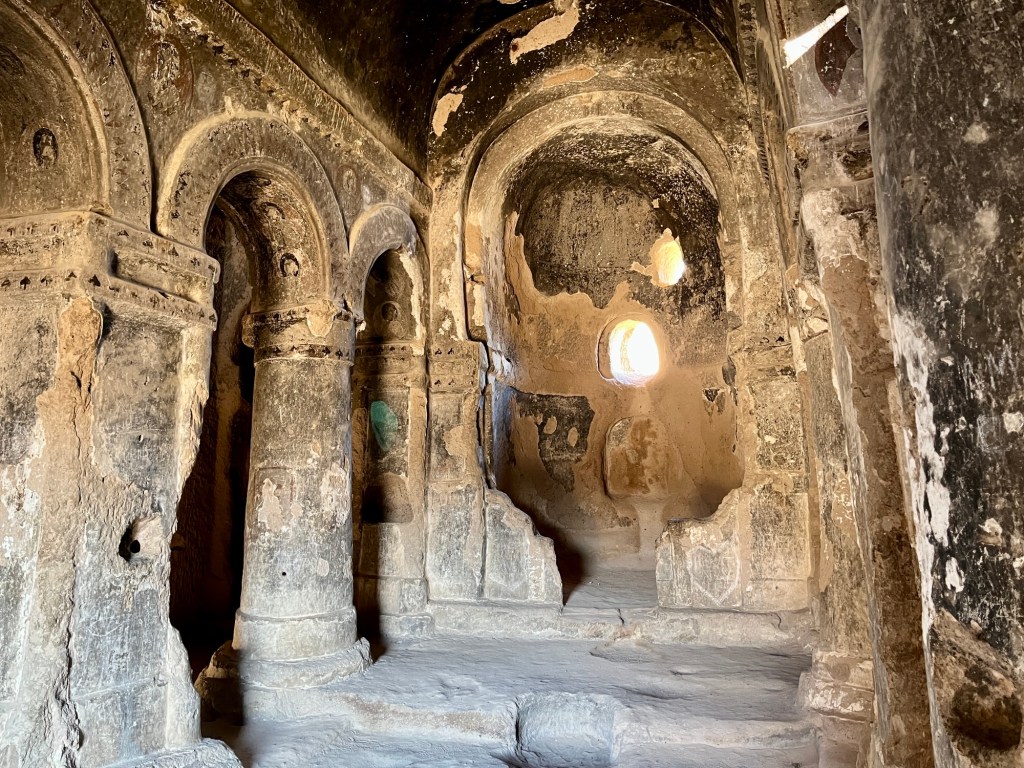
The cathedral is next, with a classic basilical structure, including nave and side aisles, as well as carefully carved columns.
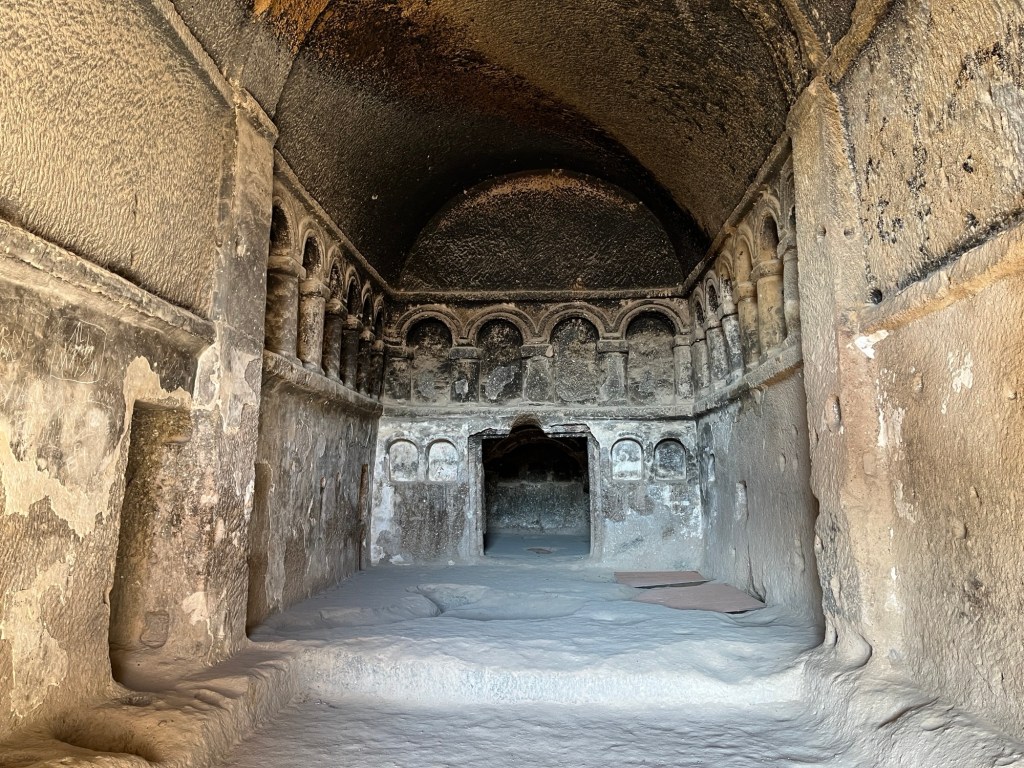
Finally the church is somewhat larger than the cathedral, but not nearly as nice.
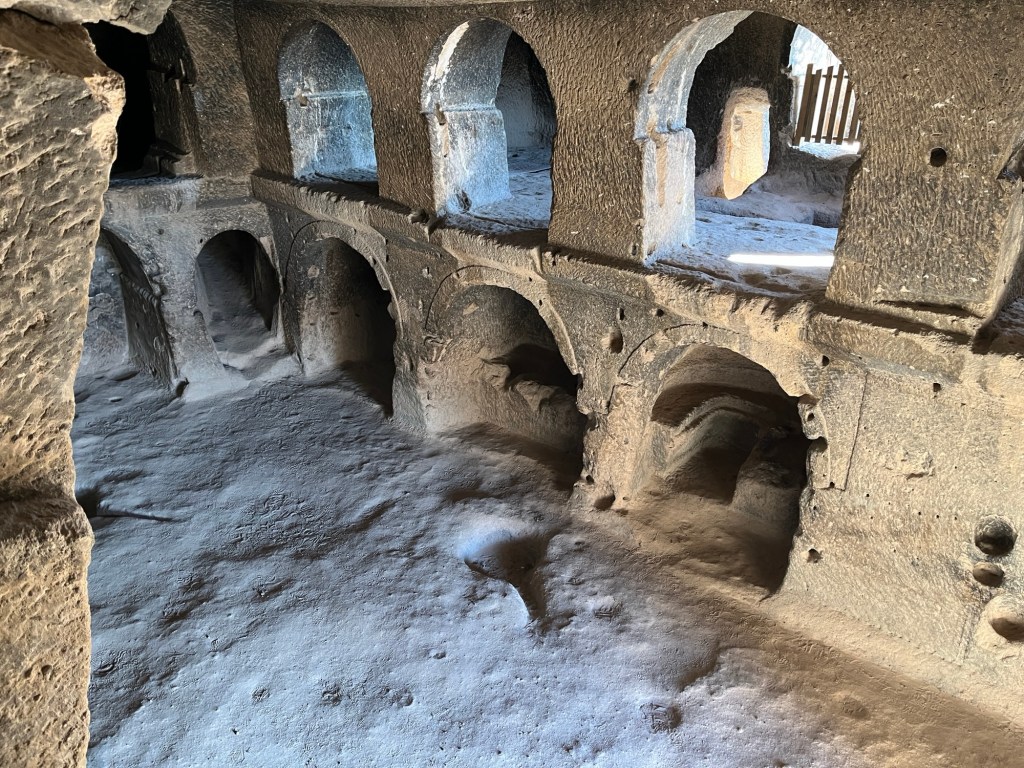
The inside of the monastery is a lot of fun to explore, with twisting tunnels linking the lower and upper levels. We all used our phones for light to aid our navigation there.
After lunch we found our way back to the underground city of Kaymakli, one of numerous underground cities in this region.
The age of these cities is unclear, because no artifacts exist for proper dating. Surface structures have been documented into the neolithic period (8,000 BCE), but it’s not really known whether these cities were at least partially constructed then, or at a much later time. More definitive findings show evidence of construction in 1000-2000 BCE, but the major expansion took place during the Christian Era.
This was really the gem of the tour today, going into this underground city, and walking these ageless paths.

The ceilings are low in places, and we have to hunch over to move around. This is not a place for the claustrophobic.

The rewards, however, are beyond words, with images of intersecting caverns and niches, and rooms connecting in every direction.

And there was this church.

And this rolling doorway to hold back invaders.
It is estimated that they could store enough provisions here to hide out for four months.
We are only allowed to explore a bit of four levels. There are eight levels in total, and other parts of the city are in dangerously poor condition.
And those four levels were enough to capture my imagination and make my trip.
This is so much better than I could have hoped.

 butterblogger