My friend Andrew flattered me recently. He said “If I was told a friend was going to North Korea, you would be one of the 5 people I would suspect.”
I find it very complementary that he thinks I’m that adventuresome, but also a bit curious that he finds me so lacking in judgement. Then again, he’s not the only one with such an opinion of me: when I’ve told people about this trip I haven’t always specified where I was going, often just stating I was going to “Korea.” Several people have looked up from whatever they were doing, eyed me suspiciously and said, “South, right?”
As though I was somehow trying to find my way into North Korea (I am most definitely NOT doing so.)
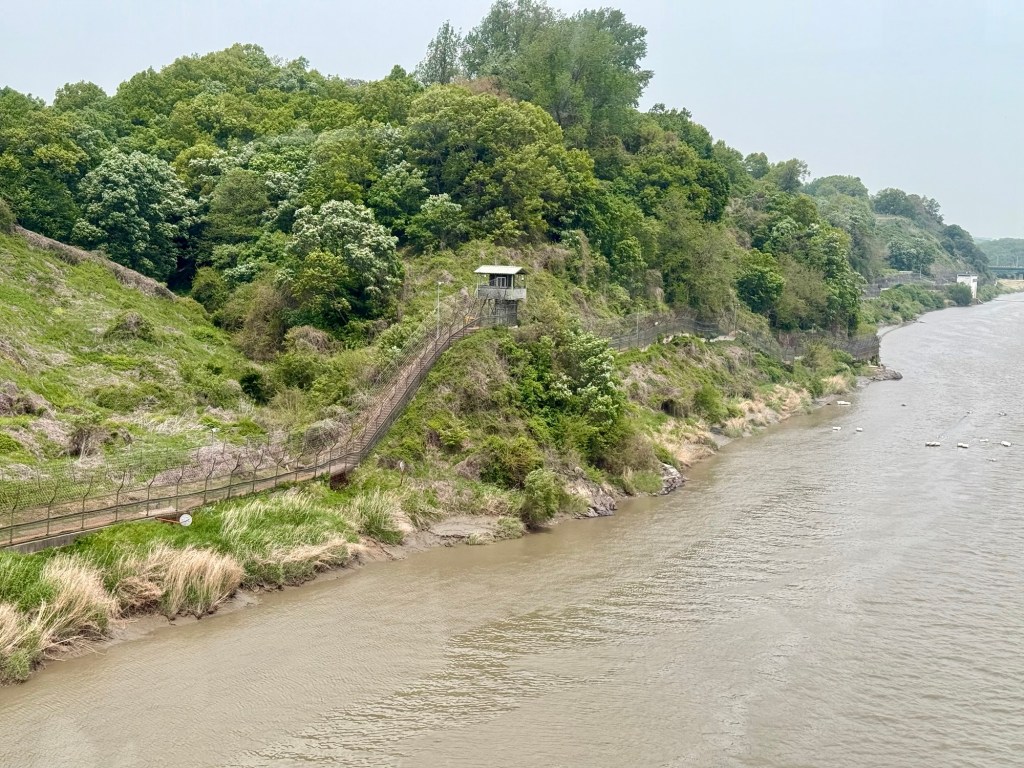
Today would be as close as I would get.
Tours of the DMZ are a very big thing here. They are a top-rated activity on TripAdvisor. When you look at various tour aggregators, several such expeditions are listed, and they all have numerous glowing reviews.
When choosing a tour, I like private if possible, but private tours are generally much too expensive for somebody who travels alone. Instead I tend to opt for small group tours, with 6-8 being an ideal number, although 12 OK. I didn’t have a sense of how big any of these tours were, but apparently there is just a standard number: DMZ tours must have at least 30 people.
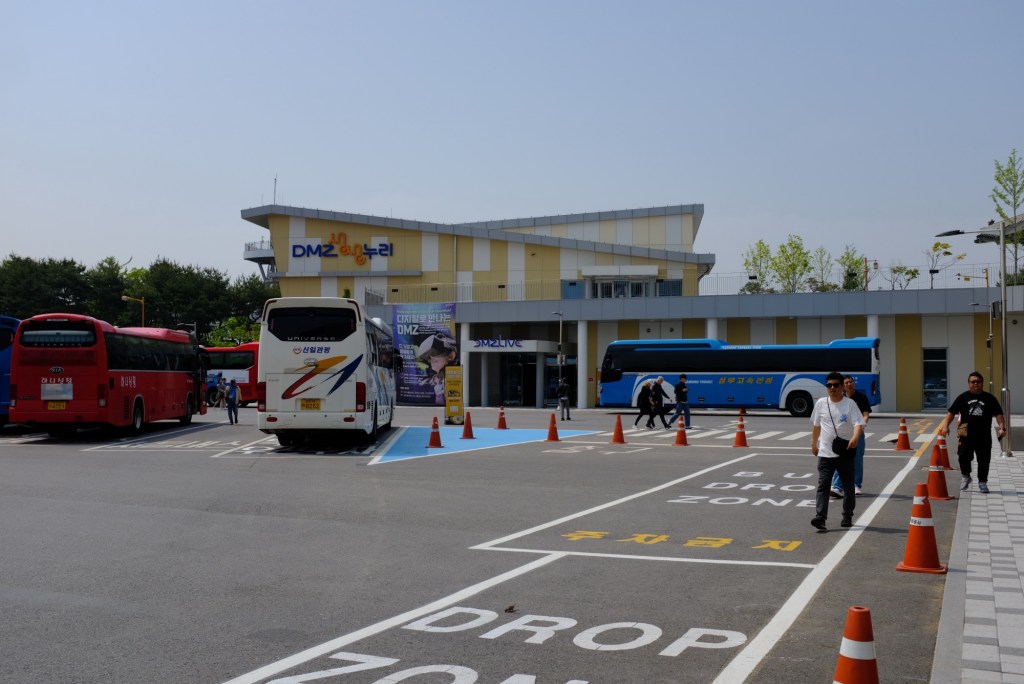
The tour itself was interesting, and I’m glad I went. We were collected in Seoul by our guide Kelly, who spoke a lot on the hour long drive to Imjingak Park, where the tour really started. They have a small collection of DMZ related activities here.
The big thing here was Freedom Bridge. This is the bridge where, at the end of the war, South Korean POW’s walked their last few steps back to the South after being released from imprisonment by the North.
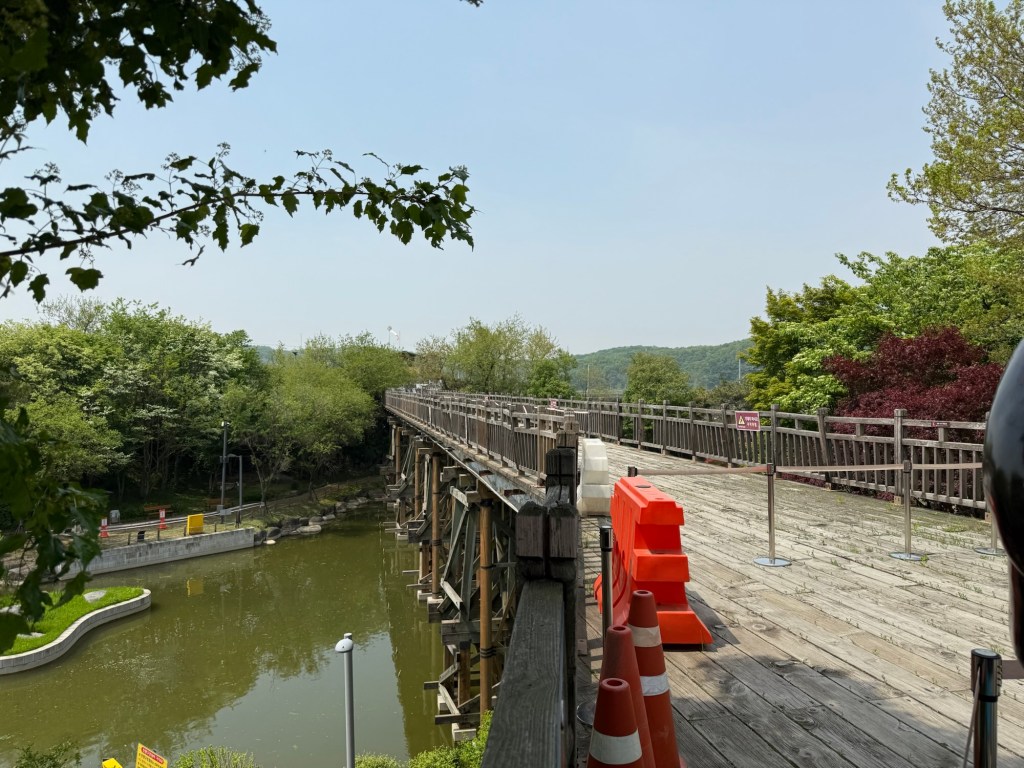
There’s some lack of clarity on nomenclature. The sign describes this small structure: “Freedom Bridge takes its name from the return of 12,773 prisoners of war in 1953 in the first exchange of prisoners after the signing of the armistice agreement that ended the Korean War….The repatriates were taken to Freedom Bridge by trucks, and they crossed the bridge on foot. Freedom Bridge is 83 meters long, 4.5 meters wide, and 8 meters high. It is a wooden structure reinforced by steel.” Sorting through some of the confusion, this might also be the Bridge of Freedom.

This structure, crossing the Imjin river, is also described as Freedom Bridge.
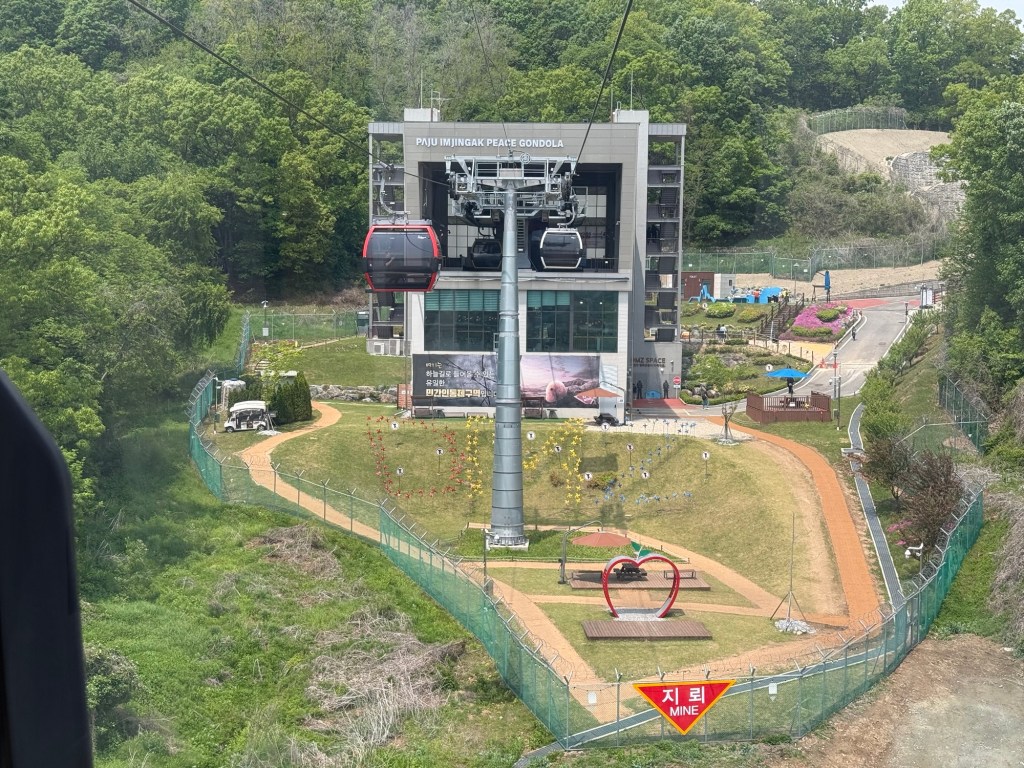
I got that photo from a gondola on a ride to the north side of the Imjin River (Imjingak Park is to the south). The area just north of the river stands in the civilian control zone (CCZ), a secondary buffer the South Korean government has established beyond the standard DMZ.

Even though it’s not the DMZ, there are still plenty of landmines here. If I had been tempted to scale a fence, these signs would have likely deterred me.
I returned via the gondola, and boarded the bus. We headed out from Imjingak Park and crossed as a group into the CCZ on our way to the actual DMZ. To do this we all had to have our passports inspected.
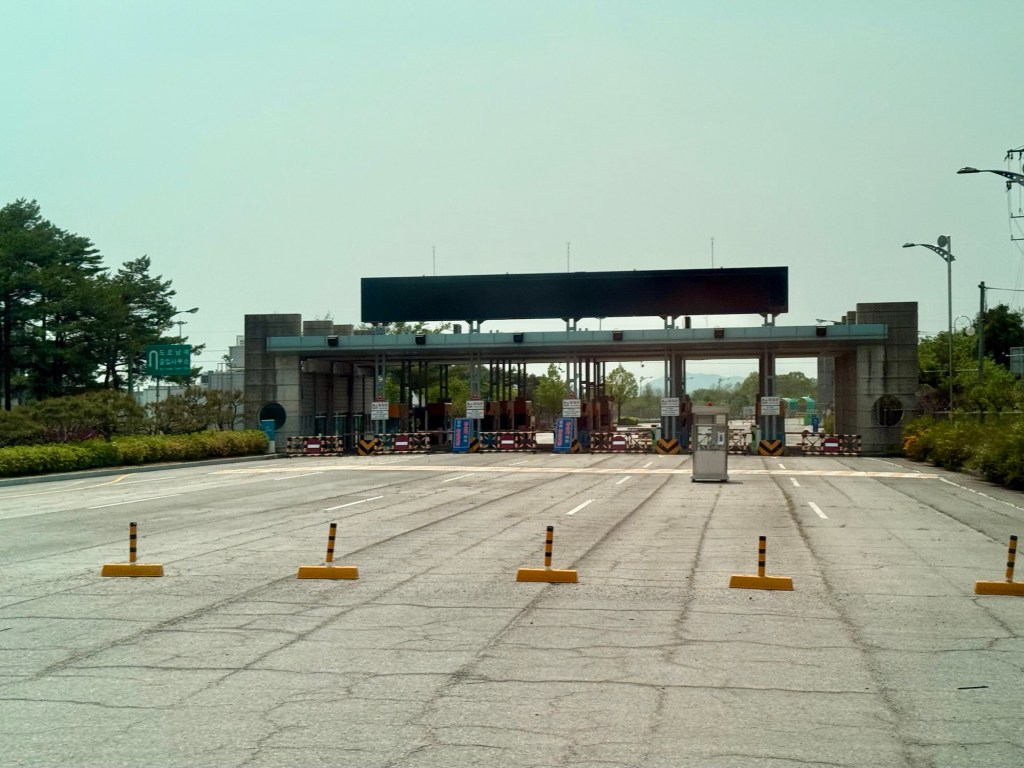
As the bus drove deeper into the CCZ, our guide directed our attention to this control point – north of there the road leads directly to the DPRK – nobody goes that way.
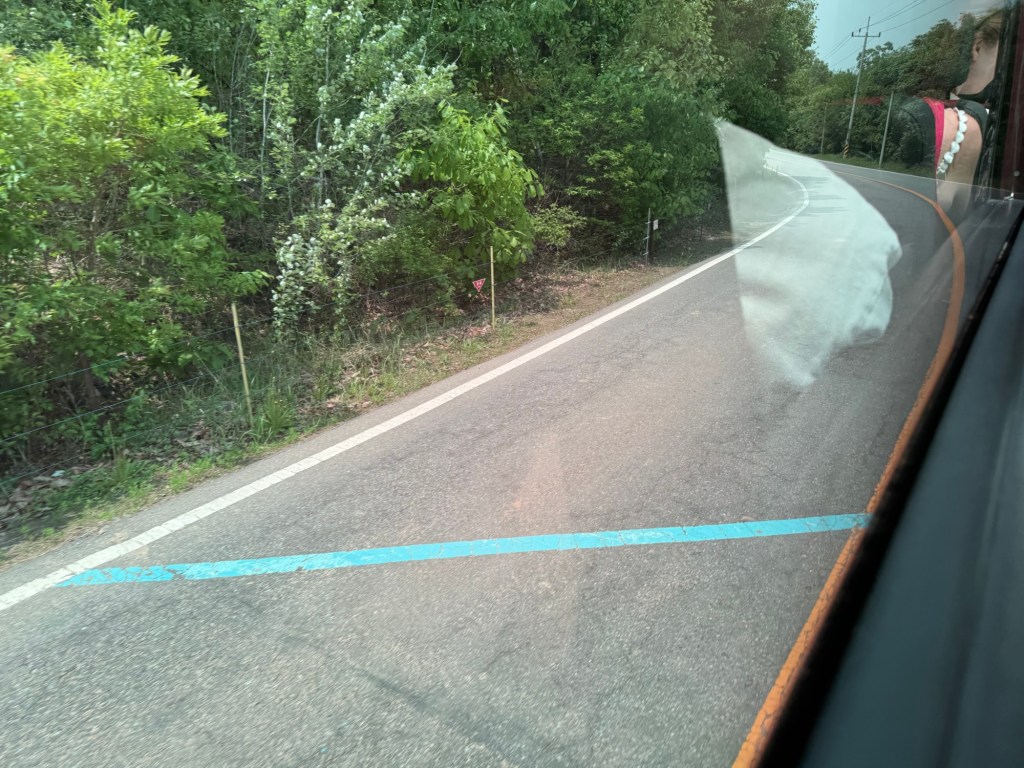
Shortly after that, we actually entered the DMZ. It’s this blue line on the road. Technically I don’t know if it’s considered the DMZ anymore, because the fence has long since been moved, but that’s what we were told (on later consideration, it probably is still the formal DMZ, as I’m fairly certain its borders are described in the armistice).
We stopped next to visit the Third Infiltration Tunnel. North Korea has built several such tunnels for the invasion of South Korea. I don’t remember how it happened, but several years ago I had a minor obsession with the DMZ (it lasted a few hours) and I learned about such things as the infiltration tunnels (4 have been identified, but 20 are suspected to exist) and the possibility of a Korean Wall, so this was all very fascinating for me.
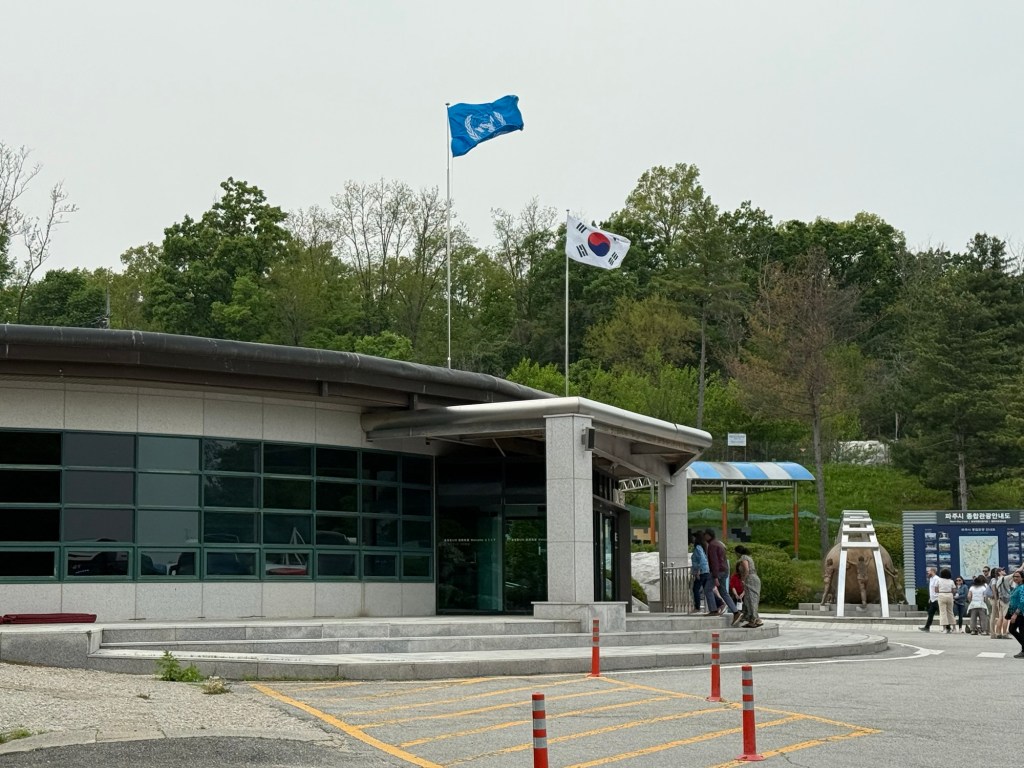
To enter the tunnel, they made us wear hard hats, which is probably good because many of us hit our heads repeatedly. One person had even managed to bloody his forehead despite wearing the hat.
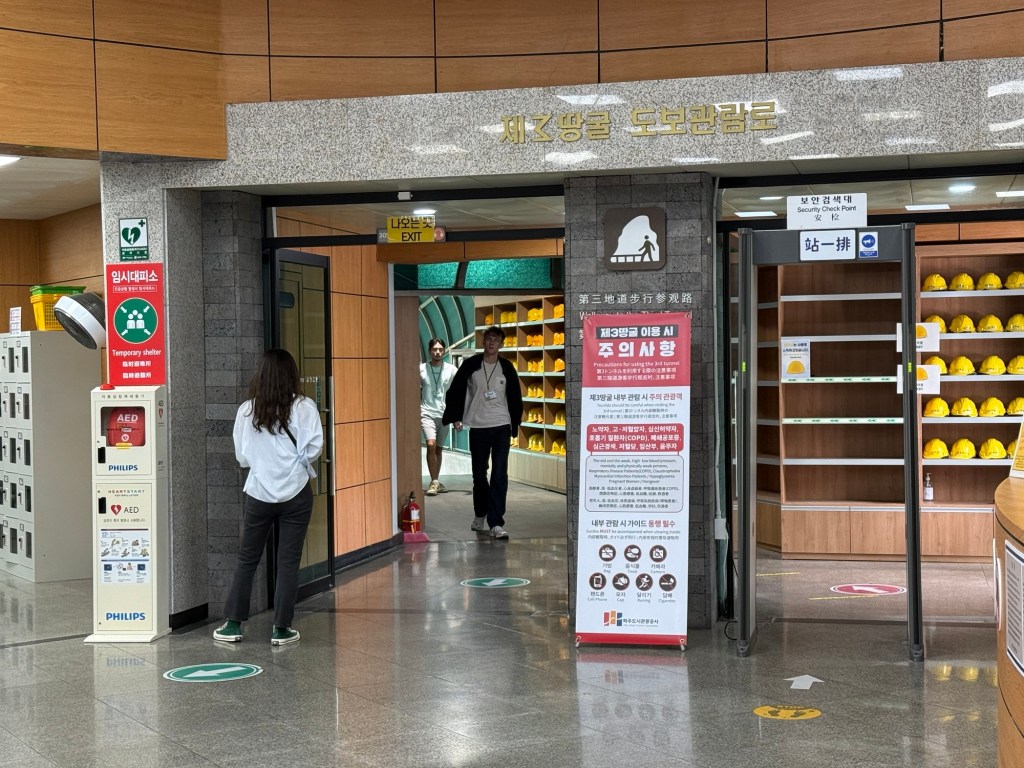
I would have some great photos here, but they wouldn’t permit us to take photos in the tunnel so this is the best you get. (They are quite restrictive on photography during these tours.)
We arrived next at the Dora Observatory, where we were welcomed with the sound of large speakers broadcasting the news (and sometimes KPop) to the north.
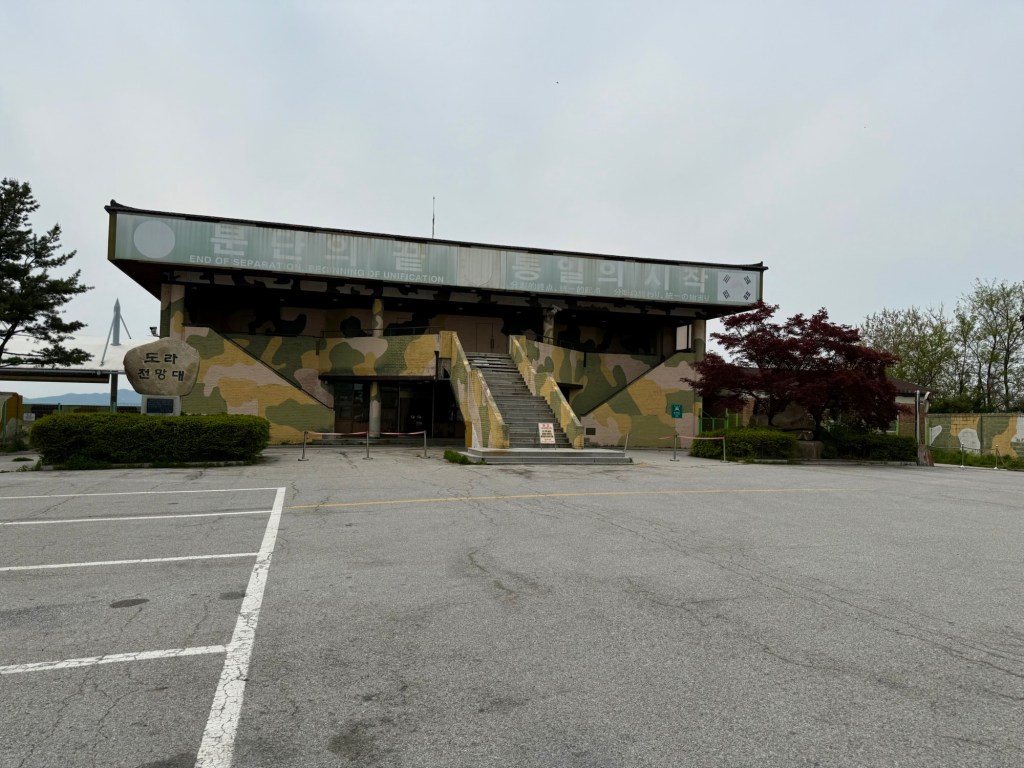
The old observatory, with its hope for reunification, now sits abandoned, replaced with a shining new building to the east. Here we gathered into a large auditorium from which we gazed through clear windows to the North.

Once again we weren’t allowed to take photos, but in the distance, through the fishbowl wall, we saw a few small settlements and the world’s tallest flagpole. Our guide described what we were witnessing, and most of us just took in the the spectacle silently. She also told us that a few months ago this site was closed to visitors, because North Korea was sending balloons with garbage in this direction.
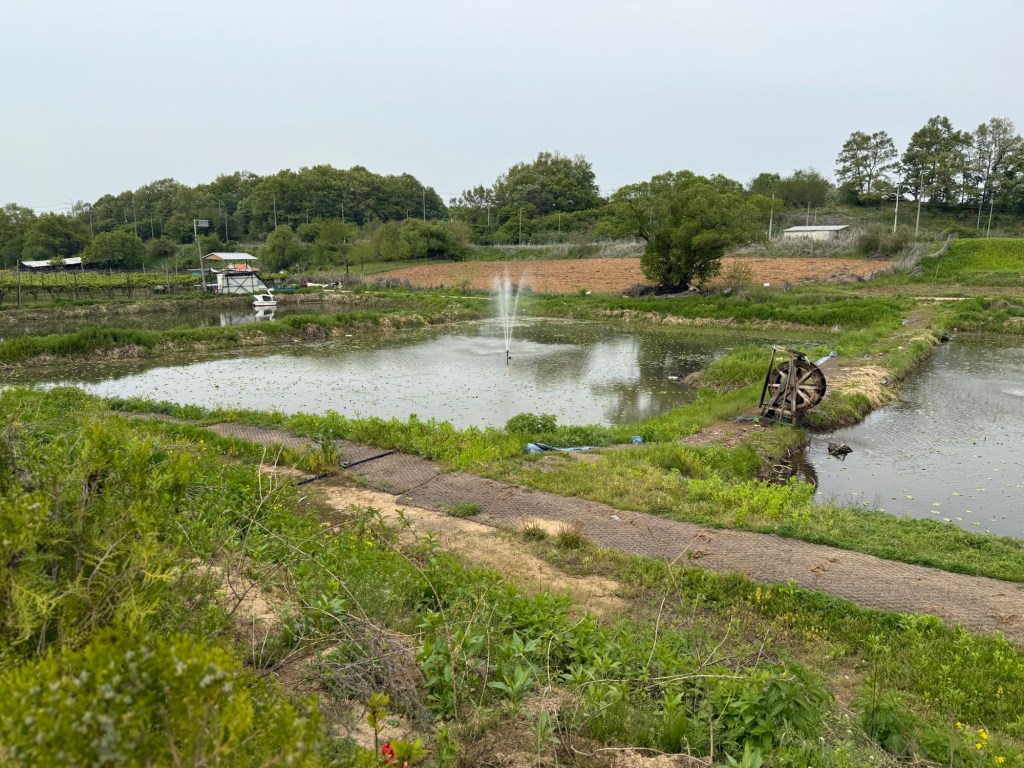
Our last stop on the tour was a place called Unification Village, which stands in the CCZ. People here grow rice, soybeans, and ginseng. There wasn’t much that I got here other than some thoughts to take home with me.

You see, I had much to consider on the ride back to Seoul. Kelly had started the morning at this monument in Imjingak Park, where divided families can send blessings to their families in the North.
She had spoken today of families separated by international borders and the passage of decades, as well as the attempts that have been made to reunite them. She showed us Unification Village and Unification bridge. She showed us the shared factory at Kaesong in the North.
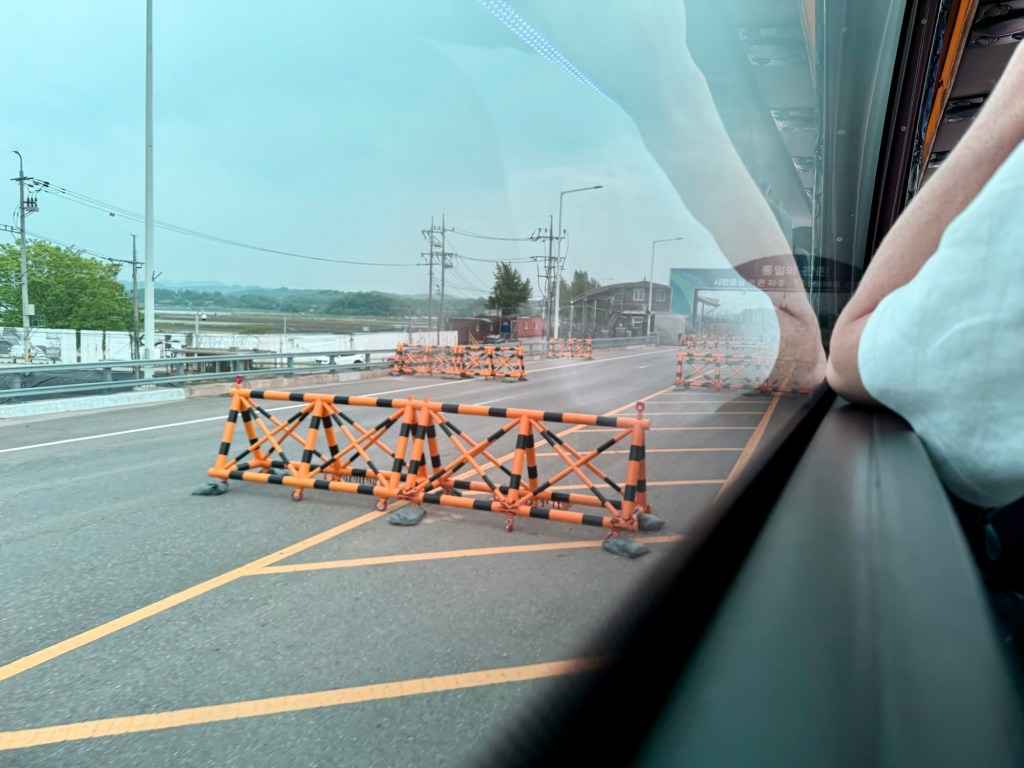
Seventy years after the signing of the armistice (the nations remain technically at war), unification seems no closer for Korea.
Yet nonetheless they speak of it anyway. I’ve noticed that they don’t call themselves “South Korea,” they are just Korea. They have a train station ready to go at the edge of the DMZ, all set for the day they will be able to hop aboard and ride all the way across Asia until they reach Europe.
Because after everything that has happened, they still they have hope.

 butterblogger