I listened to Hasmik, our guide, speaking to half of the tour bus in Russian, understanding only one word being spoken again and again: Ararat
Switching seamlessly to English, she explained the importance of Mt. Ararat. It is the tallest mountain on the Armenian Highlands and once stood at the center of the Armenian nation. It is central to Armenian identity.
The great mountain is sacred not only to Armenians, but to Christians everywhere, as this is where they believe that Noah’s Ark landed after the great flood.
It is not a place that one should attempt to climb. It is not for the people of this world.
And yet in 1921 when the Russians took control of Armenia they ceded the mountain to Turkey.
They have been a people bereft since.
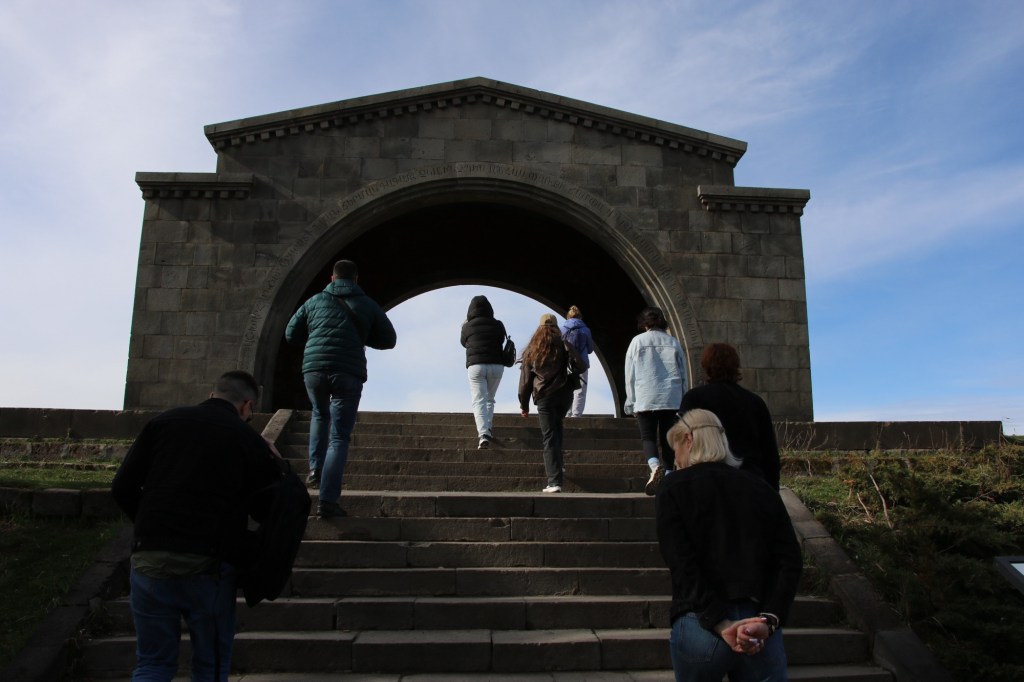
Our first stop, then was at Charents Arch, built in 1957 to commemorate the life of the poet Yeghishe Charents who wrote of his love for the mountain. This was his favorite place, and where he was rumored to have been shot during one of Stalin’s purges in 1937.
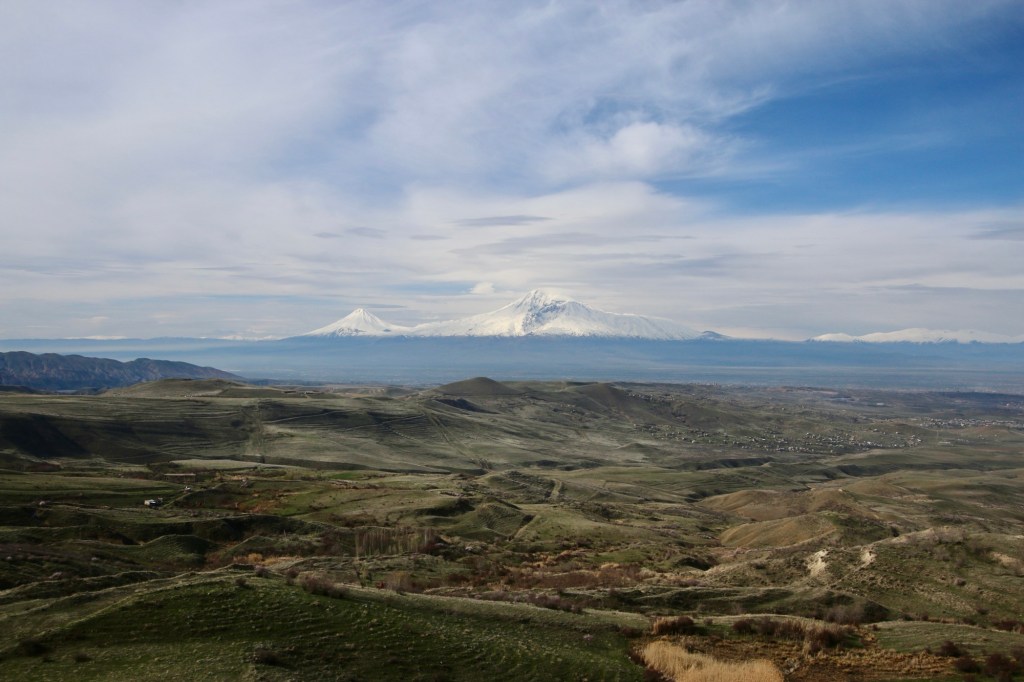
The view of the mountain is breathtaking, with the great hulking peak eternally enshrouded in snow on the right and the lesser, more graceful, peak to the left. In the summer, the smaller peak will lose its snowy covering and meltwater streams will form, but no rivers flow from Ararat.
This is but a brief stop, after which we move on to the east, the land becoming ever more mountainous as great rugged cliffs rise up about us.
Eventually we arrive at Geghard Monastery, nestled high in those precarious lands.
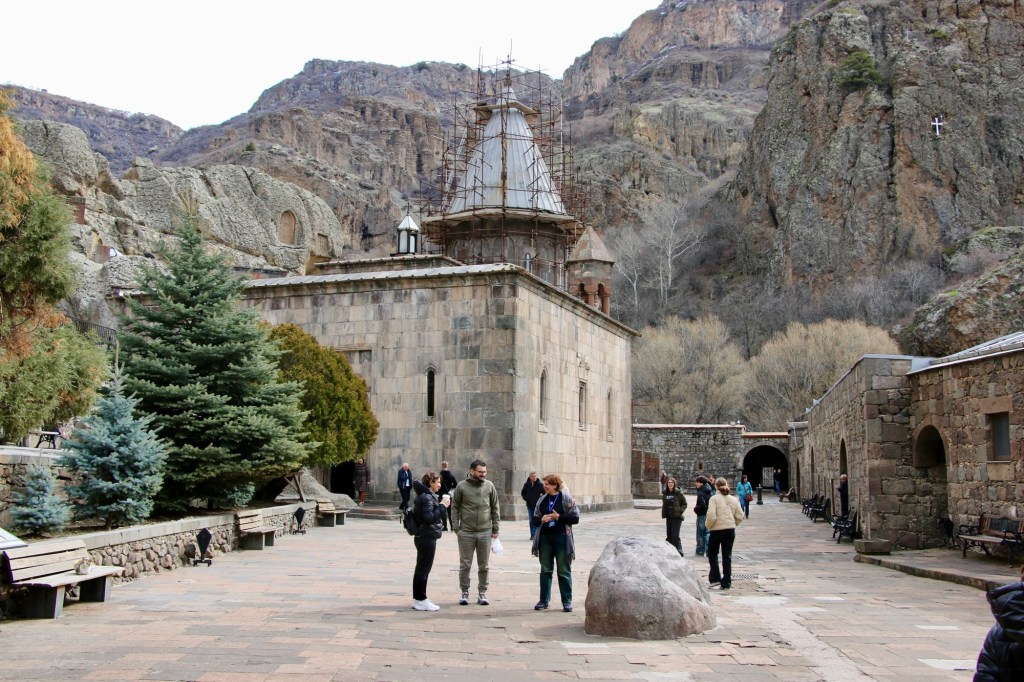
As we approach, we crane our necks to catch a view of intimate stone church, its conical dome ensconced in scaffolding.
There is more here than meets the eye, however. Although the current monastery is newer, dating to the 13th century, the site is much older, having been a monastic refuge since the 4th century, when St. Gregory converted the Armenians.
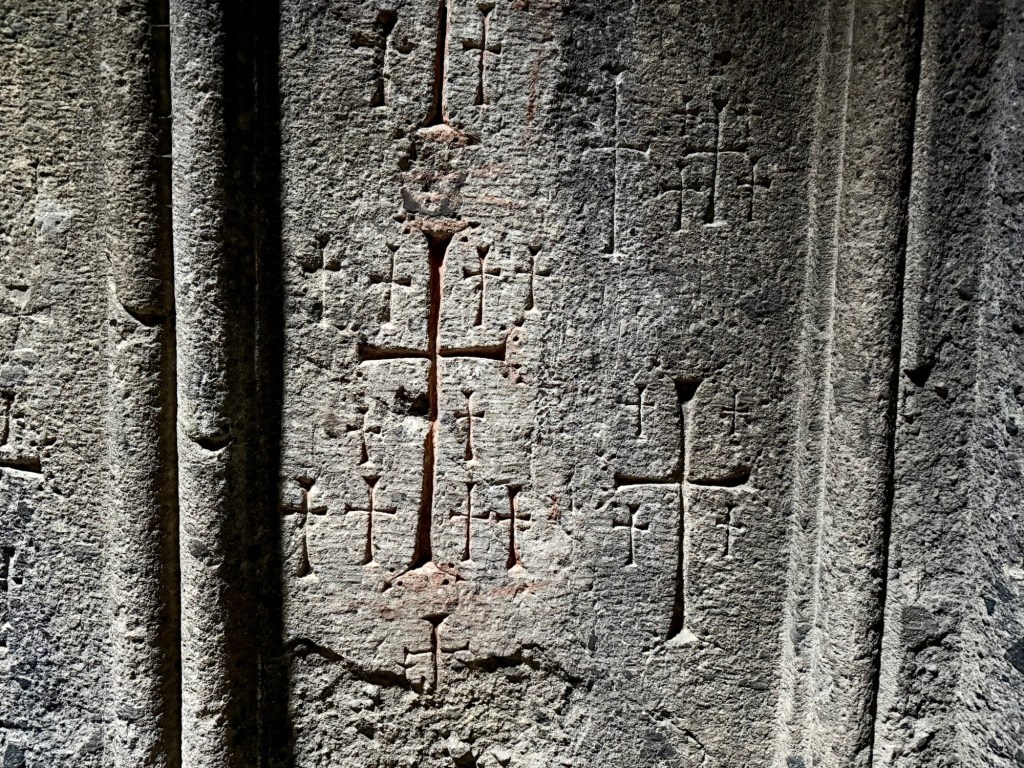
This is a holy place, and the weight of its antiquity hangs like incense in the air. Armenia was the first nation to convert to Christianity, news of Christ having been brought by the Apostles Thaddeus (Jude) and Bartholomew. On that journey, it is told, Thaddeus carried with him the lance that pierced the Christ’s side as he hung upon the cross. The lance was housed here for centuries until Russian conquerors briefly moved it to Georgia. Once again, however, it is home in Armenia, at Etchmiadzin, the mother cathedral of the Armenian Church.
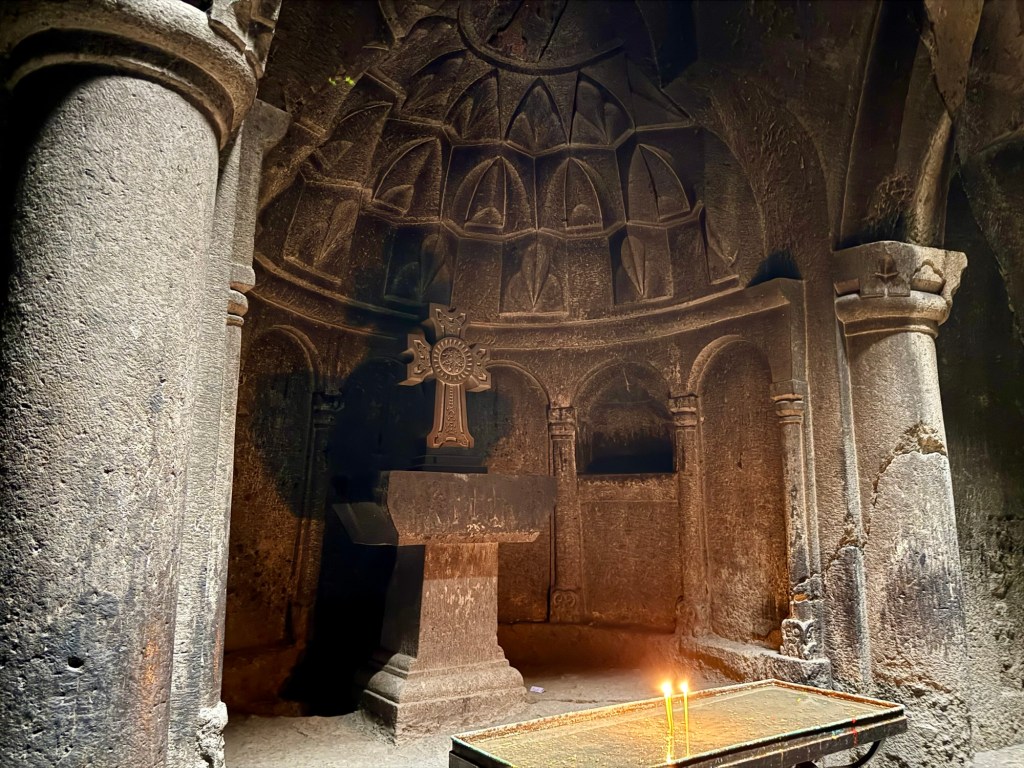
The visible church is but a small portion, as buried under the ground are other churches carved by hand from the stone. Central to each are four columns, placed for safety, to protect from the frequent earthquakes that hit the area.
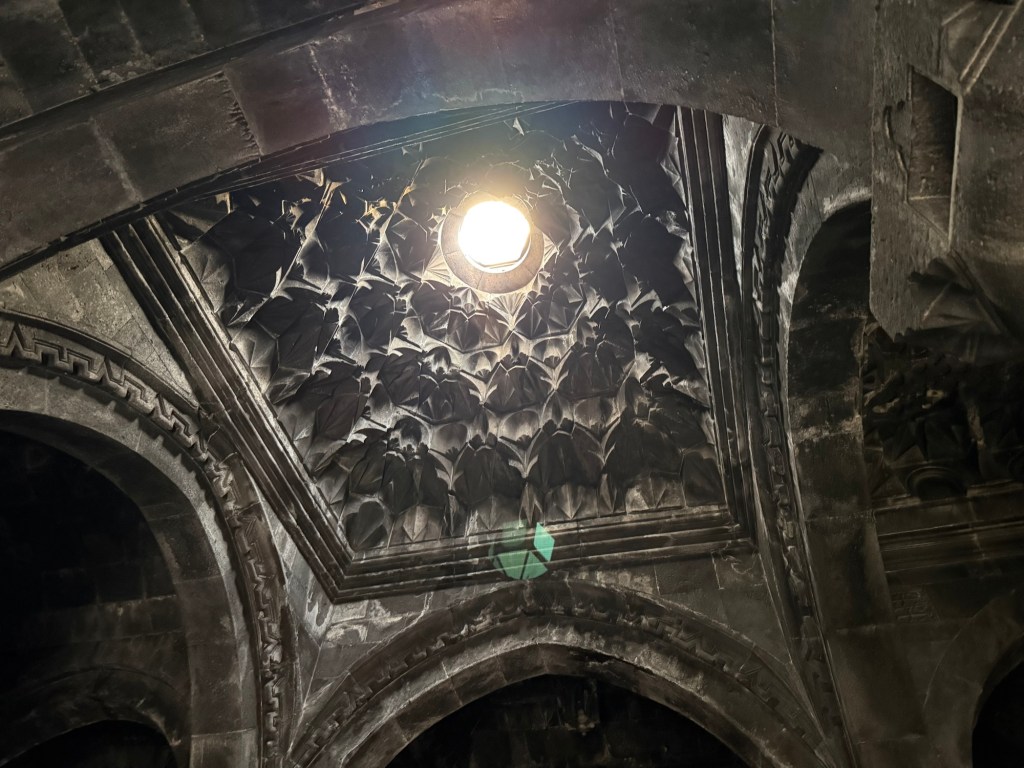
Above, is a dome with a single opening to admit light. The interior of each dome is crenellated to mimic the shape of stalactites.
As with many such sites, there is an older history still, predating the structure itself. As many sacred sites have been repurposed over millennia, Hasmik points to where water flows from one of the caves. Even in pagan times, this was a revered space.
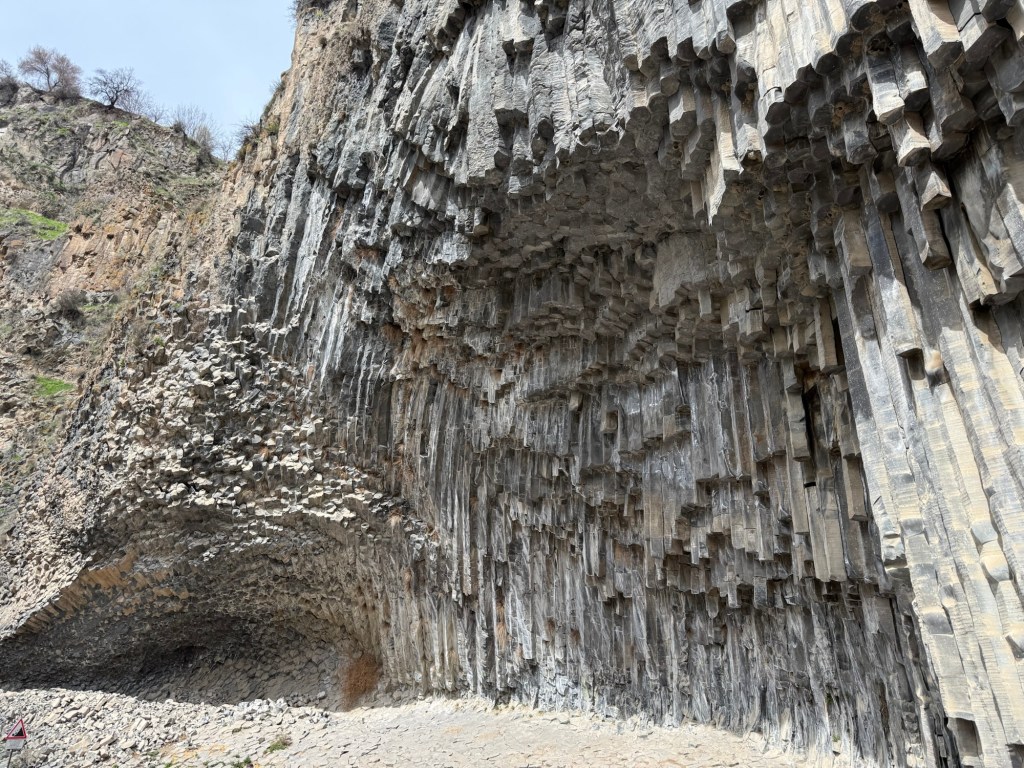
Back in the bus we stopped for a walk at the singing stones, a canyon of basalt formed by volcanic eruptions in geometric precision. They hang about us like a pipe organ and are lovely, but this feels like a distraction and shortly we continue on to Garni Temple.
This small Roman temple, one of few such remaining structures in this part of the world, stands on an outcropping overlooking a gorge.
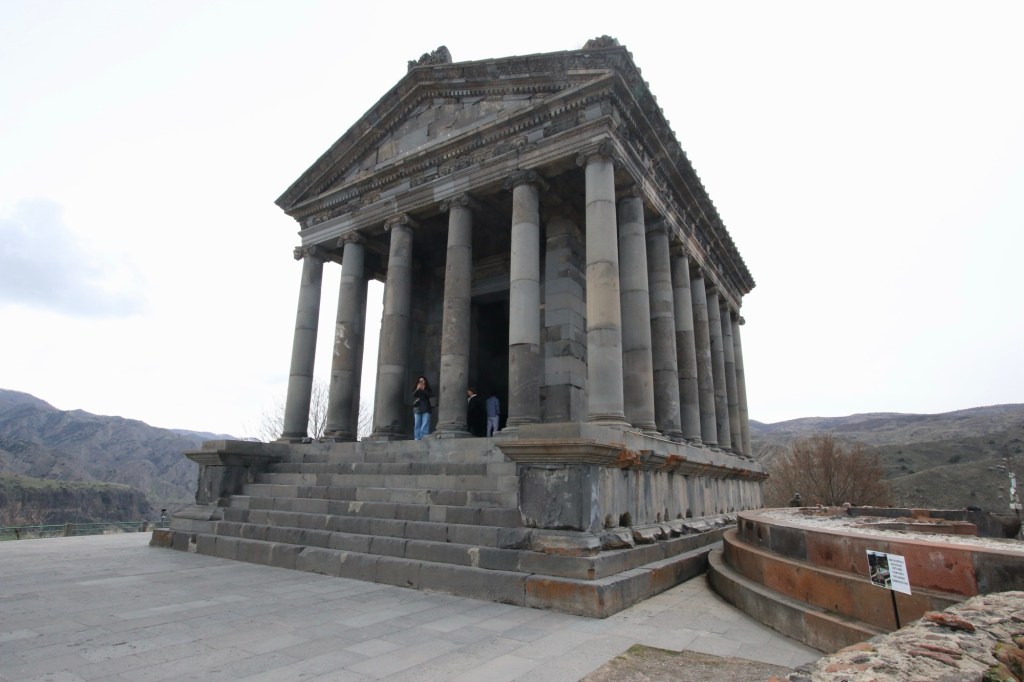
It is a remarkable structure, standing solitary on its pedestal, a bastion of the ancient world bearing witness to time as we try to understand the story it is telling.
It was built as a temple to Mithra in the first century and was eventually felled by a 17th century earthquake. Its basalt remains lay untouched at the bottom of the gorge, waiting to be painstakingly rebuilt in the last century.
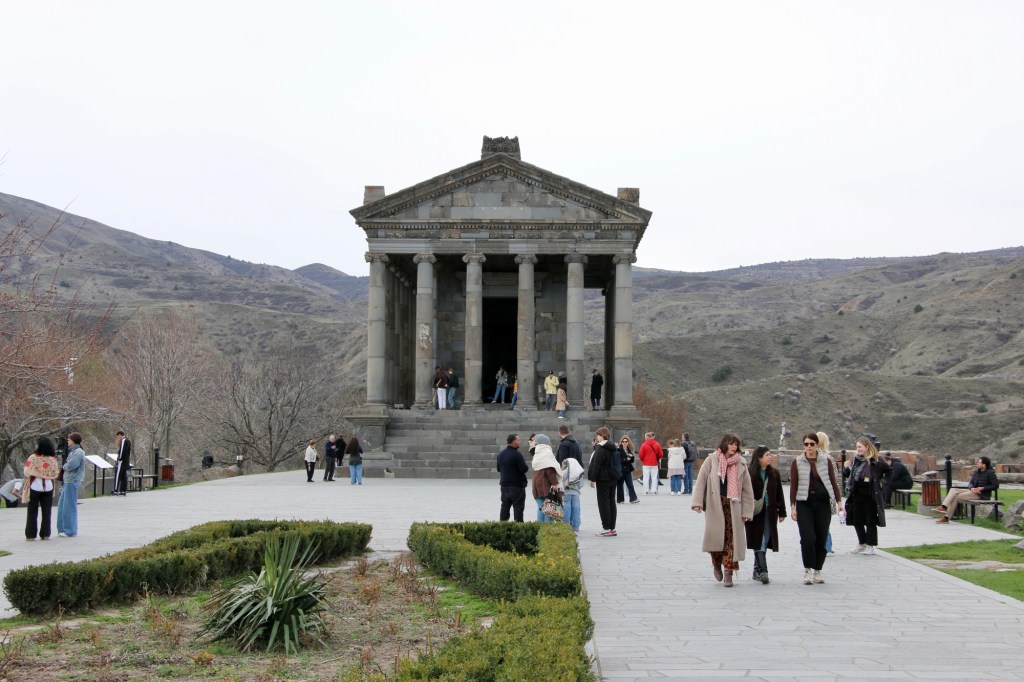
Approaching the ancient temple, I scanned the structure looking for the telltale cross. In the West it would have long since been converted to a church, or been destroyed, but here it stands as it once stood.
Hasmik answered my question before I asked it. They don’t know why it was preserved but it was thought to have either been incorporated into the royal household or used as a tomb.
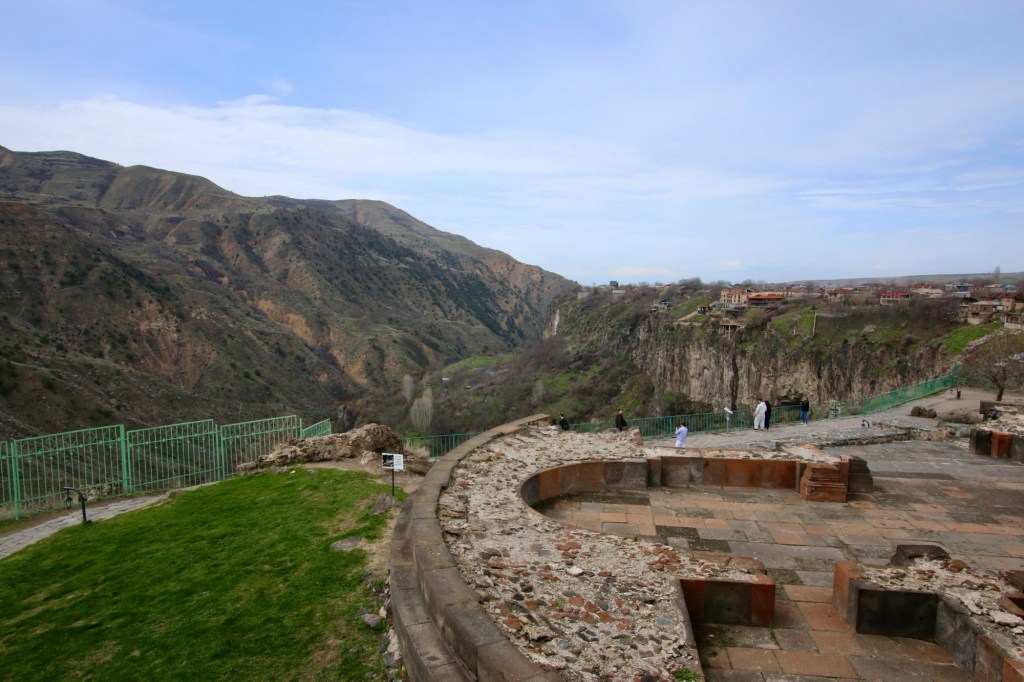
Adjacent to the temple lie the remains of St. Sion church, once constructed of tuff. This stone is softer and easier to work than basalt, so most of its structure was scavenged over the intervening centuries or worn away by time. Little remains to rebuild.
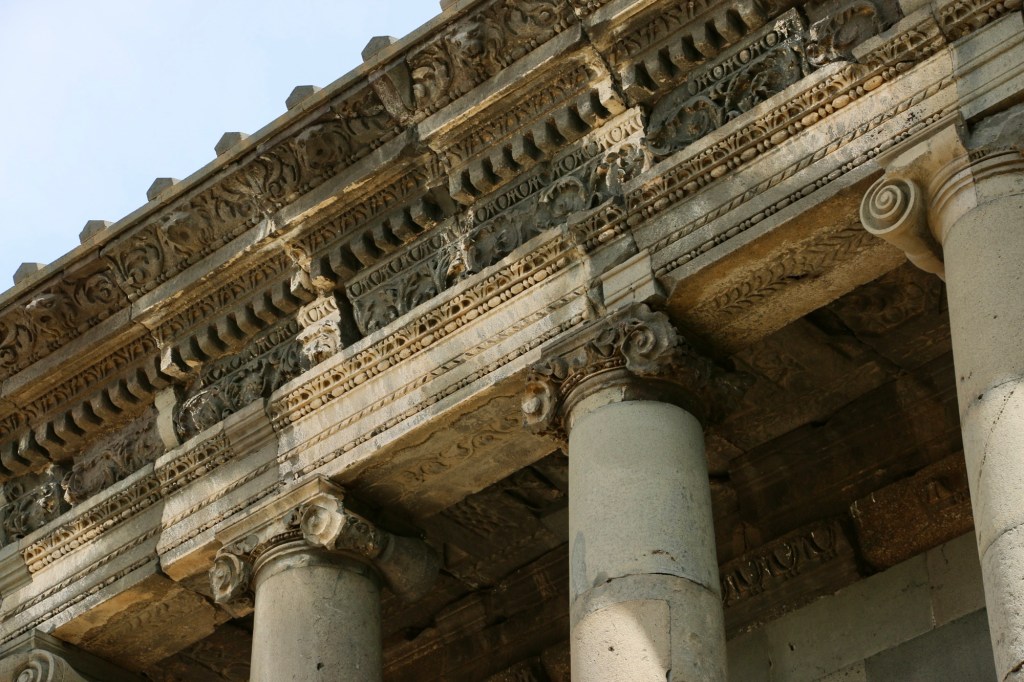
Moving through the day I am struck by the history here, how much has been lost or taken away, and how much they have hidden away in the hills.
And through it a message comes through about the Armenian people. Their history is marked by great loss – through the actions of time, earth, and man.
And still, they remember.
Still, they endure.

 butterblogger